Started on the 11th April 2011 - Blogging from a 20 year old Fashion Student
Showing posts with label 70s fashion. Show all posts

Sunday, 1 September 2013

BRIAN DUFFY


FASHION PROFILE: BRIAN DUFFY

"David Bailey, makes love daily,
Brian Duffy, bald and scruffy"
- Joanna Lumley

One third of the trio of photographers who helped define the 60s as an iconically fashionable era. 

Born: 15th June 1933
Famous for: Photographing in a more youthful and urban way - breaking free from the "neat" styling of the 1950s. 
Style Characteristics: His style of photography included iconic portraiture, voyeuristic editorials and album sleeves (most notably for David Bowie's "Alladin Sane").


Fashion
As a young art student living in London, Brian Duffy became less and less enthusiastic about his chosen pathway, fine art. He became transfixed on clothing, fashion was becoming more and more outrageous and exciting as the 1950s were coming to an end, as was the last of wartime rationing. 
   The most obvious "jump" from painting to fashion was to become a fashion illustrator, Duffy was employed by Harper's Bazaar. At his time there, however, he accidentally stumbled on another art form which would be the medium to drive him into a household name. These unsuspecting contact sheets from an editorial shoot caused Brian Duffy to become a fashion photographer. He later joked in an interview that taking photographs of clothes was the easier option; be that as it may, he became a master of his craft.

Duffy's photography catapulted models into stardom as he began capturing the change in British fashion that was happening in the 1960s. His most notable clients at this were Jane Birkin, Joanna Lumley and Grace Coddington. However, as he began to become more well-known internationally, he began to take portraits of icons such as Brigitte Bardot and Ursula Andress. Brian Duffy was proudly recording all of these fashions and muses, which are now so evocative of the 60s. 

The Photographic Trio
Fashion changed in the 60s, as we all know for obvious reasons - such as the end of rationing fabrics in the war; children from the "post war baby boom" were growing into teenagers and wanted to differentiate themselves from their parents etc - it had evolved into a more innovative business. Fashion (womenswear) transformed from being primarily glamourous, feminine, accentuating and demure to graphic, 

So you would have thought that a business that had become so fast-paced and innovative would evoke competition between all those in the same field. Not the case with the photographic trio! These photographers came to define the Swinging Sixties and managed to become well known as friends rather than opponents. They all came from similar working-class backgrounds and were known as the "terrible three", which definitely suggests mischief! 
   One of Duffy's favourite models, Joanna Lumley recited a poem in a recent interview, "David Bailey makes love daily, Brian Duffy, bald and scruffy" - emulating their notoriety as fashion photographers. The formality of the 50s was abandoned and the spirit of the 60s was captured on their film, Duffy's studio became the centre of swinging London and although the poem suggested David Bailey was the most promiscuous of the three, they all encouraged the well known bohemian motto of "free love".

Bailey became known as the womaniser, Donovan, the wit, however, Duffy was the enigma - hard to please, afraid of no one, with a seemingly underwhelming exterior. 

"If you're going to have a best friend, he may as well be a shit-head."
- Brian Duffy talks about his relationship with David Bailey

Bowie
Although, by the 70s, David Bowie was already nearing the height of his fame, Brian Duffy's vision catapulted him into a new realm of success. As Duffy was a fashion photographer, he knew that Bowie needed an image that would shock and evoke intrigue. Fashion photography is basically advertising, advertising clothes, a lifestyle... So an album cover was pretty much the same thing, advertising Bowie, projecting his music, image, clothes and lifestyle to the world.


The pair were visionaries, and continued to work together to create three album covers, each of them as iconic as the last. 

Pirelli
In 1965 Duffy was asked to create the second annual Pirelli calendar, it was shot in Monaco and was filled with extremely sexual images of women - to be sent out to very select clients of Pirelli. 
   It featured nudes and glamour photographs of the elite models at the time. A position which, today, is reserved for controversial/celebrity photographers such as Terry Richardson, Karl Lagerfeld and Patrick Dermarchelier.

The calendars celebrate the female form, and the ways in which photography and fashion changes drastically over time, it is an excellent way of seeing how our perception of the perfect female body has adapted - androgyny in the 60s, voluptuousness of the 70s, to "heroin chic" of the 90s.

The ninth issue of the calendar, again shot by Duffy in 1973 was the result of a collaboration between him and British Pop Artist Allen Jones. This resulted in quite a lot of tension between the duo, as their chemistry wasn't as jovial as the dynamic relationship demonstrated by the terrible trio.
   Jones was an artist, not a photographer, so he expected Duffy to create the images from sketches he had done. And as I said previously, Duffy wasn't afraid to stand up for himself. He did eventually shoot versions of Jones' artwork, however, it wasn't as exact as the illustrator would have liked!

Brian Duffy carried on creating extremely successful pieces of work in all areas of his photography career (fashion, music, art and advertising); despite that, he decided to give up photography in a very final and abrupt way. Duffy burnt all his old negatives and film in 1979. 

Although a large portion of his images were lost, the pieces that remain showcase his talent impeccably - they are a definitive collection which capture the changes in British fashion and culture spanning twenty-five years.

Duffy resumed photography in 2009, recreating images of models and celebrities he had shot in the 60s and 70s, possibly as a way of reminiscing and trying to reconnect with his past. He died a year later.

Brian Duffy directed the music video 
for Spandau Ballet's "Gold" (I wanted to leave you all with something a bit more cheerful!)

Wednesday, 14 September 2011

BARBARA HULANICKI

Fashion Profile: Barbara Hulanicki


Barbara Hulanicki built her brand "Biba", named after her younger sister, from a mail order company. It soon grew into one of the most influential and popular clothing shops of the 60s & 70s.

Born: 1936
Famous for: Founding BIBA, so popular in the 60s and 70s that is has been relaunched in England.
Style Characteristics: Maxi dresses and bold, individual prints.

Early Life
Barbara Hulanicki was born in Warsaw, to Polish parents, however she was brought to England at a young age. 

Hulanicki studied at Brighton School of Art, and began an early career drawing illustrations for popular fashion magazines such as Vogue and Tatler.
   These illustrations were extremely ornate and led to her designing her own clothes, rather than drawing others'...

Mail Order
Although Barbara only had a few designs, she began to sell them in small quantities through adverts in newspapers such as The Daily Mirror. 

Hulanicki was surprised that the designs sold out so fast as she could only afford to produce them in one size and style. The first design she sold was a pink gingham dress, similar to one style icon, Brigitte Bardot, had worn around the same time. 

As popularity grew, Barbara Hulanicki felt pressure to create her own brand and line of clothing. This led to the launch of "Biba". 

The first shop was in Kensington, a fashionable part of London at the time it opened in September 1964. The shop opened at 10am and everything was sold out by 11, "no one asked if there were any other styles or sizes".

The shops' main target market was teenage girls as in the late 50s/early 60s, there weren't any specialist clothes for fashion conscious teenagers. Barbara observed this and created a revolutionary brand specifically to bring new styles of dress to an audience that was in need of a change.

Big Biba
After many changes in location, Biba had evolved into a brand. Hulanicki was now designing for everyone - menswear, children's clothes, maternity wear and make-up were now added to her collection. 

In 1974, Biba was housed in a seven-storey department store (attracting up to a million customers weekly). It became a tourist attraction as Barbara Hulanicki had created a shopping experience as well as a brand.

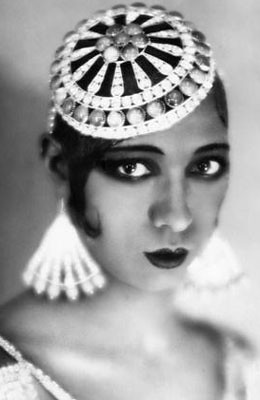
It soon became known as "Big Biba" and the Art Deco-interior was reminiscent of the Golden Age of Hollywood. Although Barbara was introducing new styles to fashion conscious Londoners, she was greatly influenced by the Twenties. The models and sales assistants wore dark make-up, not dissimilar to that worn by Josephine Baker or Louise Brooks.

"Big Biba" grew in popularity, and was favoured by the rock and fashion glitterati (such as Twiggy, Bianca and Mick Jagger).

Biba's Demise
Bib Biba was a huge responsibility financially and Barbara Hulanicki decided to sell her company off.

Barbara moved to Miami and carried out a career as an interior designer, a continuation of her combined love for Art Deco and illustration.

Biba is Back
Since its demise, Barbara has continued designing clothes, most notably for Topshop, and following such success has decided to relaunch Biba in England. 

The designs and styles that defined the 60s and 70s remain similar, as Barbara noticed the rise in popularity of vintage fashion. 

-CLICK HERE TO READ MY ARTICLE ON THE RETURN OF BIBA-


"There is very little difference today as opposed to the ‘70s, although, there is much more choice now. Both periods share the same enthusiasm, if you press the right buttons."

-Barbara Hulanicki


&&


Saturday, 20 August 2011

JIMI HENDRIX


Fashion Profile: Jimi Hendrix

Even though he died young, Jimi Hendrix is often considered one of the most influential musicians in recent history.

Born: 27th November 1942
Famous for: Being widely considered the greatest electric guitarist in musical history.
Style Characteristics: Hussar jackets, blouses and bandanas.

Early Life
Jimi Hendrix was born in Seattle, the oldest of five children, and grew up in an unstable household (due to his sickly siblings and the death of his mother when he was just fifteen). As a result of such disruption, Hendrix grew up as a shy child.

A young Jimi Hendrix developed his music abilities on a ukelele his father had found and strumming a broomstick in imitation of his idols. After the death of his mother, Hendrix found comfort in  teaching himself to play guitar through listening and repeating records. 

Hendrix was introduced to blues by his father and was heavily influenced by musicians such as Elvis Presley, Muddy Waters and BB King.

Musical Career
Hendrix played formally in bands such as The Velvetones and The Rocking Kings, however, he didn't finish High School. He later got into trouble with the law and so his music career was put on hold as he was given the option of going to prison or joining the army. He chose the latter and enlisted in 1961.

After leaving the army, Hendrix became involved in various bands once more. His first studio recording was in 1964 when he recorded "Testify" with the Isley Brothers. After collaborating with Ike and Tina Turner, Jimi joined an R&B group in 1965, "Curtis Knight and the Squires". 

Many of his recording sessions were advertised as solo albums when Hendrix became famous through the "Jimi Hendrix Experience" with which he released three albums and performed at Woodstock in August 1969.

During his musical career, Hendrix and his friend Eric Clapton popularised the use of the wah-wah pedal in mainstream rock which allowed them to deliver such complex guitar playing.

Fashion
Hendrix was well known for his uniquely flamboyant dress sense and "Dylan-esque" hairstyle (he was famed for taking a set of hair curlers with him on tour). 

Whilst touring in London, he took the opportunity to scour the fashion capitals' streets in search of boutiques such as "I Was Lord Kitchener's Valet" and "Granny Takes a Trip" - both of which were vintage shops. It was here that Hendrix discovered military fashion and in particular, the iconic hussar jacket (worn by many musicians since).

In his early career, photographs show Hendrix wearing scarves, rings, medallions and badges advertising his support for the hippie movement made popular in the 60s.

In the late 60s, Hendrix favoured a style of hat known as "the Westerner", however, he gave it up in 1968 in favour of bandanas to go with his custom made stage costumes (often including waistcoats and shirts with fringeing along the sleeves).

Death
Allegations of murder were made in relation to the death of Jimi Hendrix, however, it is said that he died of an overdose of sleeping pills. He died on the 18th September 1970 in a flat in London.

His career and death grouped him with Janis Joplin, Jim Morrison and Brian Jones - known as the 27 club as they all suffered drug-related deaths, aged 27, all within a two year period.


STEVIE NICKS


FASHION PROFILE: STEVIE NICKS

Stevie Nicks became famous in the 1970s when she joined Fleetwood Mac with boyfriend, Lindsey Buckingham. Audiences were captivated by her soft, sultry voice; and so, paired with her floaty style, a true icon was born.

Born: 26th May 1948
Famous for: 1/4 of the 1970s Anglo-American rock band, Fleetwood Mac.
Style Characteristics: Romantic/hippie stagewear.

Early Life
Stevie was born in Phoenix, Arizona, and first learnt to sing with her grandfather (who was a dwindling country singer). She recalls performing duets with him as a young child.

Stevie's gyspy style (in both fashion and music) was heavily influenced by her love of fairy tales - a by-product of her mother's overprotective nature. Instead of going out to play with friends, Stevie would immerse herself in stories. 

Stevie wrote her first song on her sixteenth birthday, it was called "I've Loved and I've Lost, and I'm Sad But Not Blue". With this, she joined her first band, however, later met her future musical and romantic partner at High School, Lindsay Buckingham, leaving "The Changing Times" to join "Fritz".

Fritz became a popular live act, and they soon began to support iconic musicians such as Jimi Hendrix and Janis Joplin.

Fleetwood Mac
Stevie and Lindsay left Fritz in 1972 to pursue a career in music together, however, Stevie endured many years of waitressing and cleaning before her career with Fleetwood Mac turned her into the 70s icon she is today.

Nicks and Buckingham joined Fleetwood Mac at the end of 1974 (only after Buckingham insisted that he would only join if Stevie be invited into the band too - they insisted they were a "package deal" - something that paid off as Stevie is the most iconic member of the band!).

Stevie Nicks worked with designer Margi Kent to develop her unique onstage look - this often included flowing skits, shawls and platform boots (influenced by the floaty dresses often pictured in fairytales). 

Although Fleetwood Mac as a band became extremely successful, tensions started to grow between Stevie and Lindsay; Nicks eventually ended the relationship as she felt it was affecting their creativity. Despite this, the band continued to record their  album Rumours. 

Nicks' most notable contribution to Rumours was "Dreams" which was the band's only No.1 hit single. Regardless of the tensions and affairs within the band, however, they continued recording well into the late 70s.

Icon-Worthy
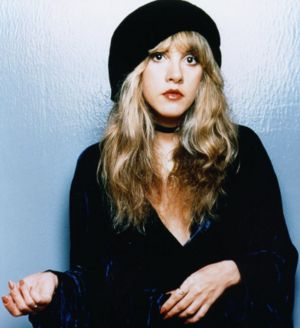
Stevie Nicks is known for her romantic image, flowing skirts, shawls, lace and long blonde hair have become her most notable style characteristics. Nicks collaborated with designer Margi Kent  in order to perfect her style which she still calls her "uniform".

During the late 70s/early 80s, Nicks adopted the style of Renaissance velvet berets decorated with plume feathers, this was a continuation of her romantic/gypsy style.

Stevie's shawls and capes have great significance within her live performances, for example, she wears red/crimson for "Sara", white for "Edge of Seventeen" and gold for "Gold Dust Woman".

Although they are often associated together, Stevie Nicks admitted to being inspired by Janis Joplin and Grace Slick (from Jefferson Airplane) as her first band "Fritz" began as one of Joplins' supporting acts.

Stevie has commented on her style in interviews, conveying her shock in finding out she was not only appreciated for her music, but also for her "Bella Donna/Witchy" image. Most of her clothing, she says, was for practical reasons. She often wore platforms so as not to feel short in comparison to the rest of the band.


"I'm timeless, I got that Dickensian, London street-urchin look in high school. I'll never be in style, but I'll always be different."
"I've always liked long, flowing clothes,...I used to rummage around in my grandmother's trunks trying to find them. I love the feeling of chiffon and lace."